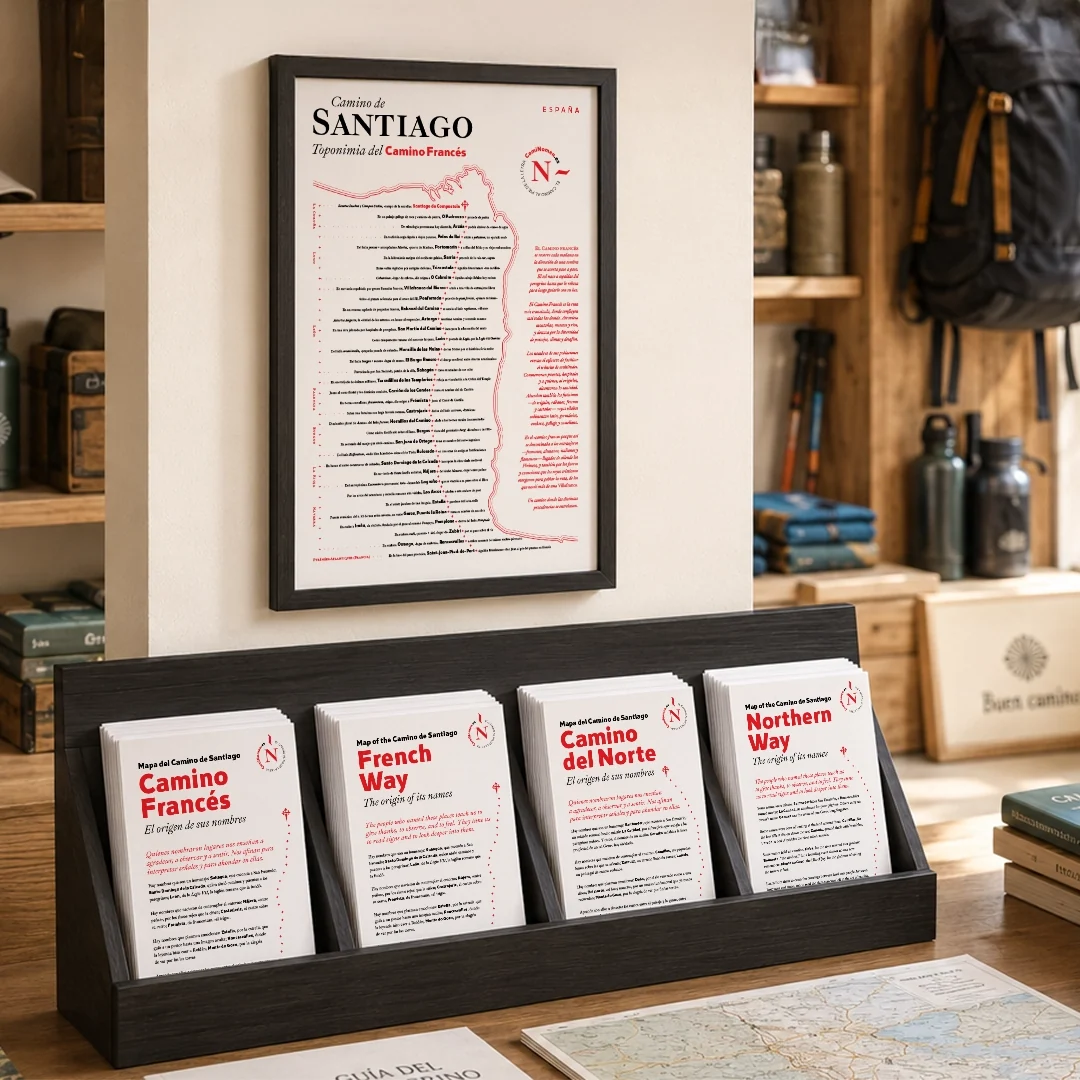
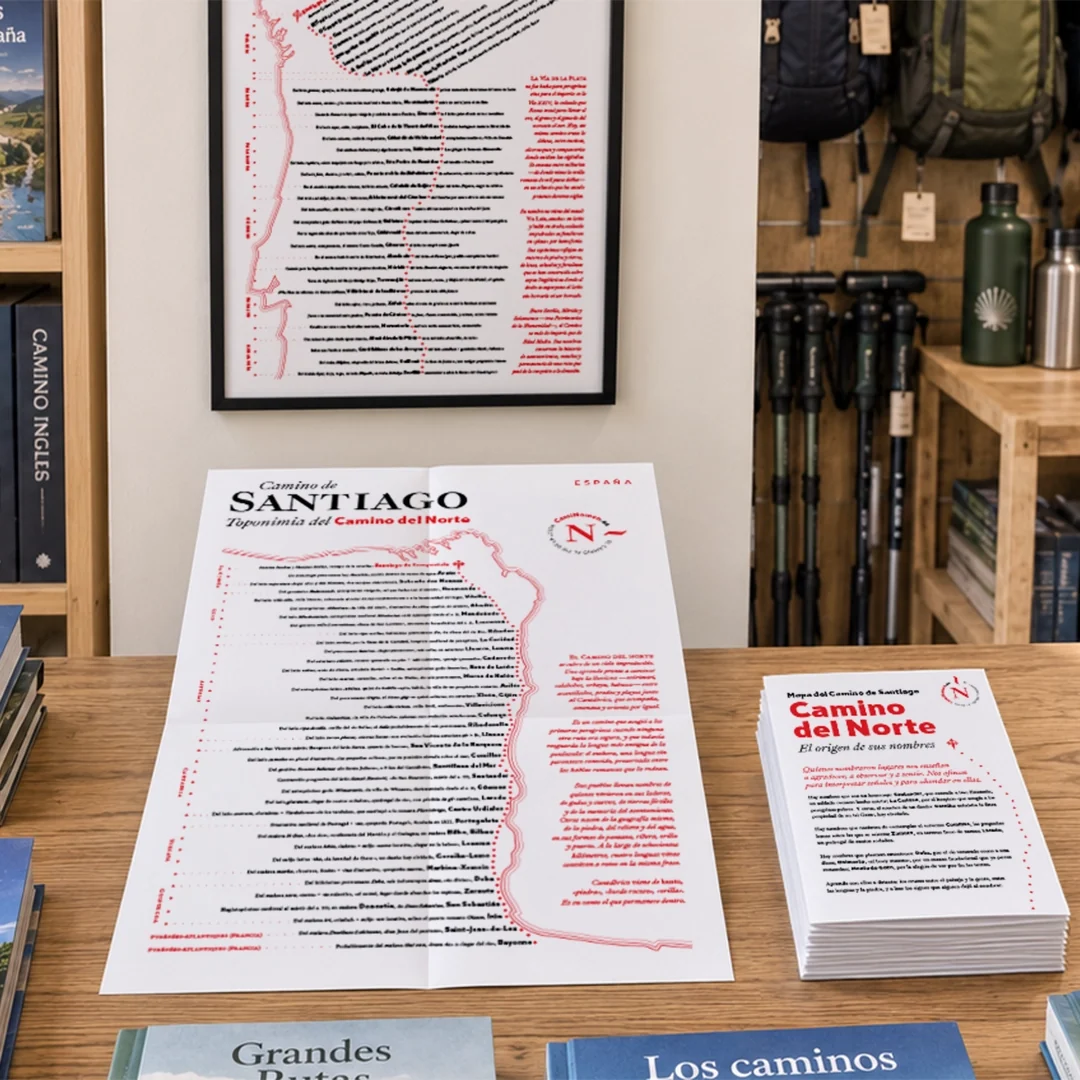
On the Camino, every name holds something. Astorga hides Asturica Augusta, the city Rome dedicated to its emperor; Sahagún hides a saint, Sanctus Facundus, worn down past recognition. Villafranca filled with Franks, the foreigners the route drew in; and Ponferrada is the Pons Ferrata, the iron bridge raised for the pilgrim.
Others are layered languages: Zubiri is “town of the bridge” in Basque; Nájera, “between crags” in Arabic; O Porriño, “the little leek field” in Galician. Estella was called star in Latin, and Lizarra, “ash grove”, in Basque.
And many spring from the ground underfoot: Frómista, from wheat; Roncesvalles —Orreaga in Basque— is the place of junipers; Padrón, the stone that, tradition says, moored the Apostle’s boat. The Camino is walked on foot. It can also be read, name by name, hanging on the wall.
The maps
The idea began by putting the place-names of each route onto a map to keep. The line of the road is drawn from the history of every place, distilled into the origin of its name.
Each map is printed in two versions, Spanish and English: you choose the language when you place the order.
Maps to frame
Made to be seen on a wall, the maps are A3 (29.7×42 cm) — small enough not to take over the room, large enough to read the detail.
Maps to walk
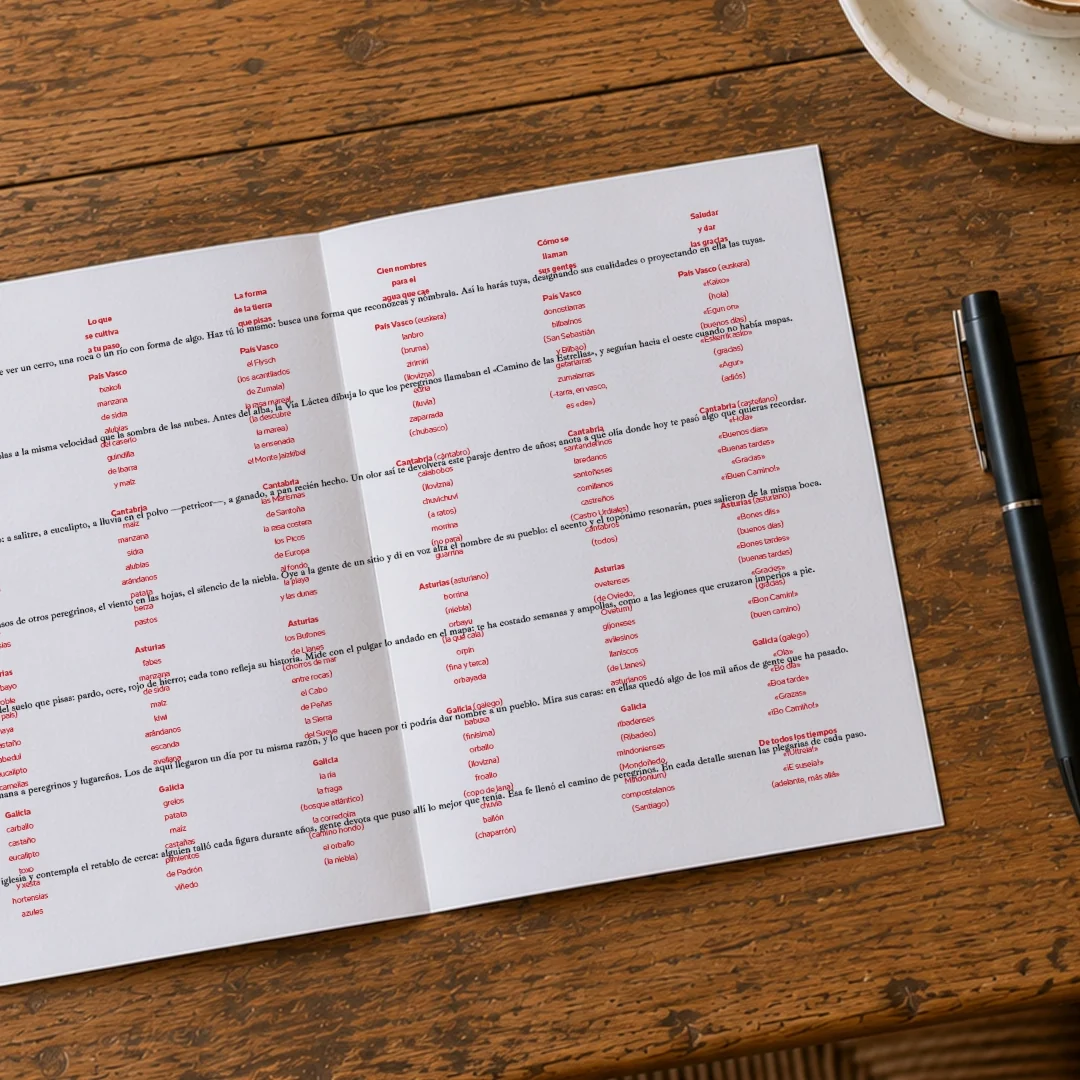
Since carrying a flat or rolled map is hardly ideal, there is also a folding version. Besides the same map you would frame, it holds facts and reflections on each route: from how to greet in every language you pass through, to lists of the plants, the demonyms, or the words for rain.
The more we know a place, the deeper our regard for it. CamiNomen wants to open the pilgrim’s eyes to the vast cultural, linguistic and historical richness held in names — and to how the Camino can be felt more fully by noticing what those who walked it before us meant to leave us.
Five names, five origins
A taste of what ends up on the wall: water, work, a coin, the joy of arriving — each name in a different tongue.
Navia
water and its gods · Camino del Norte
Pre-Roman name of the river Navia — from Navia, the Celtic goddess of waters, attested in Roman-era inscriptions. The town takes the river’s name at its mouth.
Azofra
work · Camino Francés
From the Arabic as-sujra “the obligatory labour”: land whose tilling owed a day’s work to the lord. The name outlived the 10th-century reconquest.
Mealhada
a coin · Camino Português
From the mealha, a medieval coin, plus the place-suffix -ada: “the place of the toll”. A name born of a road tax.
Carcaboso
a trade · Vía de la Plata
From the Latin caccabus “clay pot”: “the place of pots”, for the pottery that worked the clays of the river Jerte.
Monte do Gozo
joy · Camino Francés
“The mount of joy”: the hill where the towers of Santiago first come into view. French pilgrims shouted “Mont-joie!”, and the cry became the name.
The territory
From the map we move to the territory. The research gathered so much that we poured it into a site you can enjoy at home, but that would rather walk with you: as you go, it names the place under your feet and tells you where the name comes from.
We are bringing it to pilgrim offices, hostels, tourist offices and to Camino guides and operators. We plan to leave sample maps with a QR code to reach the site, where a directory of the shops that sell the maps will appear.
Desktop — the list of names for each camino: easy to search and browse.Desktop — the interactive map: every point opens the story of its name.
Mobile — search a town or tap “I’m here” and it locates you.Mobile — every camino and its stages, one tap away.Mobile — the map takes you to every place on the route.Mobile — the story of each name, clear and short.Mobile — the stages of your route to Santiago.Mobile — the official caminos, at a glance.
We want whoever visits the site to take a map. We want whoever hangs a map to dream of walking. And whoever walks to better understand every name they meet.
First in the shop, then in the pilgrim’s hands and, at last, hanging on the wall at home.
Other margins
We like the maps to be sold in places with taste. The trade price —VAT (4%) included— is half the suggested retail price.
Format
Trade price VAT (4%) incl.
Retail price VAT (4%) included
A3
15 €
30 €
Plegable
8,95 €
17,90 €
The sale is firm and at 50 %: the trade price is half the retail price, and the map belongs to the shop from delivery. No stock on deposit, nothing to return — what you buy is yours, at the best margin.
The folding map is sold firm, with a minimum of 10 units per order; shipping is included from 20 units.
Orders go through the client portal we share with UrbiNomen, our sister project: one account for the whole house.
These maps are taxed at 4 % VAT, not 21 %: that is the rate we invoice. Here is the basis.
We also walk the city
CamiNomen has a sibling: UrbiNomen, the street names of Madrid, one by one. They share makers, format, paper, price and the very same ordering portal, and on the shelf they draw another crowd: the one that loves its city and its names. Adding the other atlas is just one more line on the same order. To hang these maps is to step into a project on its way to naming everything.
Graphic designers in love with names and their history. Juan Carlos walked the Camino and came back wanting to give something back: CamiNomen was born there, from seeing the route as a string of names and wanting to tell them.
We would love to show you the maps in person and talk about whatever you need.